
The Sea Ranch Bulletin
“Connective Tissue”
January/February 2026

“In the Sea Ranch, one might view the Commons landscape as the vital, living matrix that stitches each home and its inhabitants into visual and sensual belonging with the whole. One might consider that these several thousand acres – across forest, wetland, creek, bluff and meadow terrace, are the verdant tendons and ligaments that fasten our lives and experiences of this place together into something cohesive. What I see now, after nine months of living here, is that what truly holds this place together emerges primarily from the hearts of its people. Every single act of kindness and respect that occurs between its human occupants, and between the people and the land itself adds up to everything that matters most. Thoughtful gestures offered from one neighbor to another; passionate volunteers spending weekends tending meadows, writing the CEP, or taking note of subtle changes in the flora and fauna of the terrestrial and marine realms – these moments of consistent, mindful presence to each other and to the environment around us are what define the character and essence of this place, and upon which its resilience depends. Every Sea Ranch dinner party; every act of checking in with one another through storms, natural disaster, or human loss; every instance when a design committee member reminds a homeowner to consider their neighbors’ view and well-being as much as their own; every time two individuals or two groups of people agree to disagree, but with civility, integrity and respect - this is the true glue, the collagen of this place.”
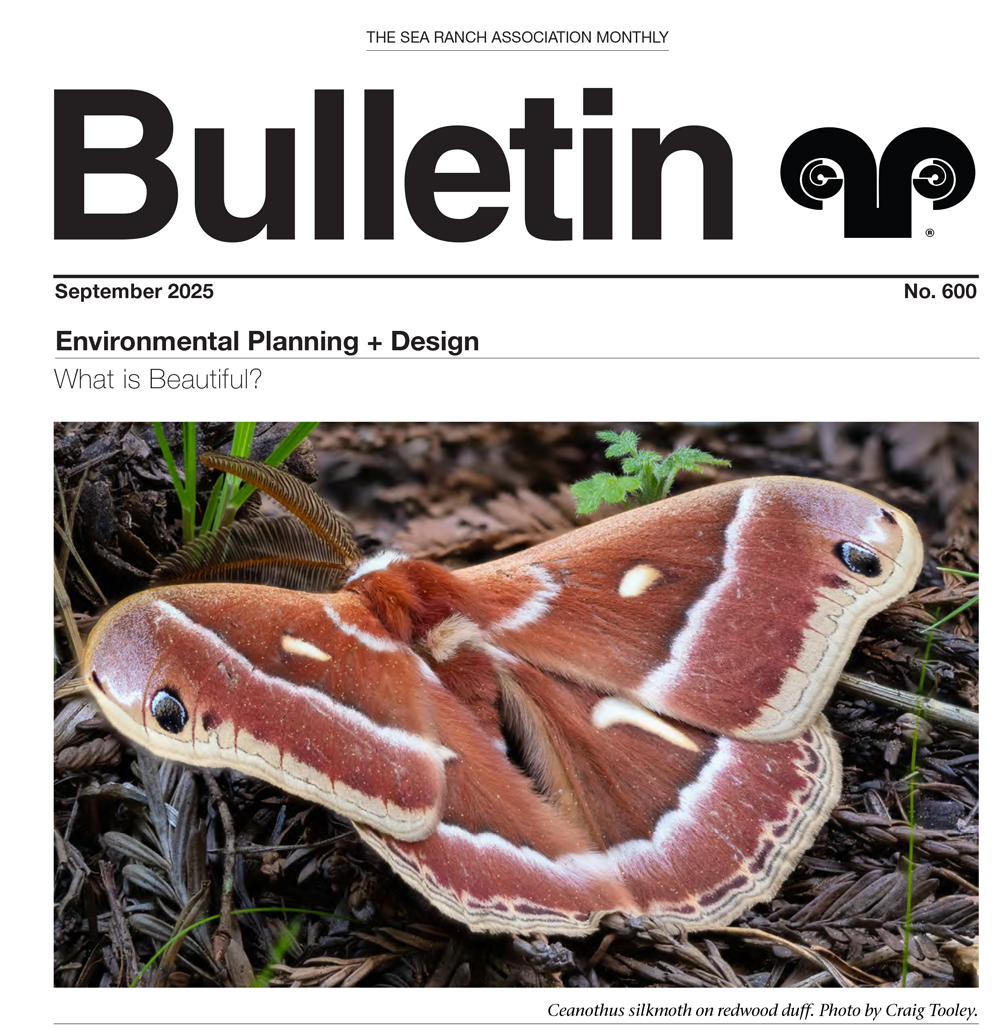
The Sea Ranch Bulletin
“What is Beautiful?”
September 2025
“It is foreseeable that (not all) but many of these trees will come down in the near future, whether we do it on our terms, or it occurs with future winter storms. I know how beloved the cypress are here, and that their decline and loss will bring grief. I hope that alongside that grief, a spark of excitement for the beauty that we hope to bring to the Commons in their wake will not just soften the hard edges of this change, but lead to a genuine source of joy and conviviality. Design in The Sea Ranch has always aimed to be harmonious with the natural world. It is a rare place which has always upheld a higher aesthetic of beauty that necessarily includes the preservation of biodiversity and the many forms of life that make this such an inspiring place to be.”

The Dirt Blog | American Society of Landscape Architects
“To Quell Ecological Grief, Expand Ecoliteracy”
Jessica Dune (Neafsey)
June 17, 2024
“Sometimes we are charged to work in very degraded landscapes, or in places that are especially vulnerable to climate change consequences such as wildfire, flooding, and sea level rise. As we are increasingly faced with environmental loss – past, present and future – we must learn how to talk about and process the grief that comes with it. This grief can furthermore encompass feelings of sadness for the prevalence of human disconnection from the natural world -- the loss of relationship that once ensured our mutual flourishing.”

Water Smart Gardens Maintenance Manual
Sonoma-Marin Saving Water Partnership
Ann Baker Landscape Architecture, Jessica Neafsey
November 2021
“The FREE Water Smart Gardens Maintenance Manual is a step-by-step guide on how and why to maintain a low water use landscape. The manual also features a maintenance calendar that illustrates when seasonally important tasks like weeding, pruning and adjustments to irrigation scheduling should occur. Following the manual will help reduce the time and resources needed to grow a vibrant, water efficient landscape.” Sonoma-Marin Saving Water Partnership

The Rubin Museum | Spiral Magazine
“A Manual For the Momentary: DIY Rituals from Reimagine End of Life: A Collective Ritual for Climate Change”
Day Schildkret and Jessica Neafsey
February 2020
“The world as we have known and loved it is changing fast. Industrialization and overpopulation have contributed to a global climate crisis that renders within our hearts a new kind of anticipatory grief.
To move forward amid growing fears we need new means to process this grief and trauma as it arises, both privately and collectively. Impermanent Earth altars poignantly validate loss through their ephemeral nature and boldly welcome grief into the public realm. Creating such altars may offer an increased sense of unity in divisive times by reflecting our shared fears and vulnerability.
This Earth altar ritual can be implemented in parks or civic spaces. It enables people to make personal and collective ecological grief visible, tangible, and more deeply felt, so we may move through it with our hearts not paralyzed with fear but rather broken open with love for our world.”
The Dirt Blog: The American Society of Landscape Architects
“America’s Memorials Can be Designed to Evolve”
Jessica Neafsey
September 2017
“Moving forward, American monuments and memorial landscapes in the 21st century may better be able to embody shared cultural values; reflect an inclusive and emotionally-intelligent view of history; mirror and support dynamic emotional processes; aid healing, forgiveness, and reconciliation; honor diversity, accept death, and truly affirm life if they are designed to consider the virtues and qualities of transience, adaptability, and vitality.”

Land and Water Magazine
“Undamming the Carmel: Restoring an Endangered River”
Jessica Neafsey
February 2016
"We are living at a point in history where nature has lost its capacity to recover in certain ways without our assistance. Conservation cannot rely on passive protection. The Carmel River Reroute and San Clemente Dam Removal Project has given us a chance to step up and act from a new 21st century land ethic that demands a highly proactive, hands-on stewardship of the wild, where profound restoration sometimes requires radical acts of deconstruction."

American Society of Landscape Architects Annual Conference
“Blank Slate Landscapes: Regenerative Undoing and Ecological Infill” lecture
Jessica Neafsey (Rana Creek) and David Yocca (Conservation Design Forum)
November 2015 | Chicago, IL
"There are many types of post-development landscapes that present exciting opportunities to reintroduce a high level of ecological integrity and authenticity in unique urban and natural contexts. Two ecological design firms described their approaches to consulting science to engender successful reclamation/restoration projects that bring incredible diversity to unlikely landscapes."

Lana’i Futures Sustainability Master Plan
Jessica Neafsey, Rana Creek
May 2014
“RANA engaged with Pulama Lāna‘i in a comprehensive planning process to generate long-term goals and initiatives to ensure a more sustainable and thriving island ecology, economy, and community. RANA performed a thorough analysis of existing opportunities, constraints, and baseline conditions, identifying key ecological design best practices and innovative technologies. Short and long-term planning goals and project initiatives were identified for ecology and conservation, agriculture, low-impact development (LID), green infrastructure, purchasing, waste-to-energy, and resource recovery. An island-wide, systems approach was utilized to conceive resilient, closed-loop systems that mimic and support island ecology, culture, and community. Considering the uniqueness of place, RANA’s approach aimed to honor the traditional ahupua’a land stewardship principle while helping to generate a scientifically informed, 21st-century Hawaiian land ethic.”

The River Runs Through it: Report on Historic Structures + Site Design in the Fishtown Cultural Landscape
Laurie Sommers, Ph.D., Eugene Hopkins, Evan Hall, Mark Johnson, Jessica Neafsey
September 2011 | The Johnson Hill Land Ethics Studio
"A detailed and ground-breaking example of a historic structures report prepared in 2010-2011 for the Fishtown Preservation Society (FPS), a non-profit organization in Leland, Michigan, which in 2007 purchased a significant portion of this historic commercial fishing village within the Leland National Register Historic District. This report, as stated in the RPF, was intended "to guide future treatment of the structures, site and landscape features in Fishtown, and to build a greater understanding of the complex built and culutral history of Fishtown and its environs."
Laurie Sommers

Saving Place, Saving Grace
Picture Farmer Films
January 2017
This PBS documentary that explores the how the monastic community at Holy Cross Abby has begun implementation of a Sustainability Plan created through our University of Michigan Master's Project: "Holy Cross Abby: Reinhabiting Place." Team and interviews include Craig Cammarata, Alex Linkow, Charlotte Coultrap-Bagg, Kathryn Buckner, Jessica Neafsey, Christopher Stratman with faculty advisor Andrew J. Hoffman

Reinhabiting Place | Holy Cross Abbey
Jessica Neafsey, Kathryn Buckner, Christopher Stratman, Alex Linkow, Craig Cammarata, Charlotte Coultrap-Bagg, Andrew Hoffman
May 2010 | University of Michigan
Abstract: "As a monastery living under the Rule of St. Benedict and as part of the 900-year-old Order of Cistercians of the Strict Observance (OCSO), the monks of Holy Cross Abbey (HCA) are pursuing sustainability not only to ensure that their traditions and spiritual way of life persevere, but also to foster a deeper stewardship of the land as “lovers of the brethren and of the place.” As part of this sustainability initiative, HCA solicited the assistance of a team of graduate students from the University of Michigan’s School of Natural Resources and Environment (“Michigan Team”) under the guidance of Professor Andrew Hoffman. As part of this project, the Michigan Team used a systems perspective with the intention of encouraging a more holistic, integrative, and telescopic view of the monastery in its local, regional, and global contexts. To this end, the Team evaluated HCA’s community sustainability as it specifically applies to the following topic areas: land use, energy, water, solid waste, toxics, economies, food, and buildings. Subsequently, synergistic recommendations were provided to help HCA become more sustainable. These suggested guidelines may also assist other monasteries and religious institutions as they initiate, evaluate, and/or modify their own sustainability efforts, thereby enhancing environmental stewardship throughout numerous communities and maximizing positive impact on society."

Wild Ones Journal
“The Role of Native Plants in the Sustainable Sites Initiative”
Jessica Neafsey
2009